

Use a 30 day Test to Ground Healing Resistance for Intuitive Women
Healing resistance is the set of protective or inhibiting internal patterns that block you from receiving or integrating spiritual and energetic guidance. The first move is never to force your way through it. Name the exact edge where you feel resistant, then apply discernment: ask a bounded, testable question before you act. Resistance can be a signal worth listening to, not only an obstacle to overcome.
TL;DR:
Resistance often manifests as delays, physical sensations, or urges to reorganize, rather than overt fear, requiring specific identification and testing.
Testing guidance involves asking bounded questions, noting bodily responses, and filtering outcomes through values, facts, timing, and consequences to discern true guidance.
Embodied practices like micro-movements and grounding exercises help integrate resistance steadily, with small, reversible experiments improving internal confidence.
Severe sleep disruption, impaired daily functioning, or loss of control signal the need to pause practice and seek medical or mental health support.
Support systems, community, and therapy can help identify and work through resistance patterns rooted in cultural, familial, or religious conditioning.
Table of Contents
What Does Healing Resistance Look Like?
Resistance rarely announces itself as fear. It shows up as a delay, a headache during meditation, or a sudden urge to reorganize your closet instead of journaling. A heuristic inquiry into spiritual resistance identified five recurring forms, and recognizing which one you are in changes how you respond to it.
Emotional resistance: a wave of grief, anger, or shame surfaces the moment you open to a download, often before you understand why.
Existential resistance: a fear that receiving this guidance will unravel your identity or your relationships.
Intellectual resistance: an urge to analyze, research, or debate the message instead of feeling it.
Low-agency resistance: a sense of helplessness, as if the guidance is happening to you rather than through you.
Expectant resistance: waiting for a bigger, more dramatic sign before you trust what you’ve already received.
The same heuristic study found that fear and cultural conditioning are frequently the real engine behind these forms. Resistance is not always the enemy of your growth. It can also be the part of you asking for a slower pace, a clearer boundary, or more evidence before you leap.
How Do You Test Guidance Before Acting On It?
Discernment is the practice that separates a grounded channel from a reactive one. Rather than surrendering blindly or dismissing every download as noise, you build a short routine that tests what you receive against your values, your facts, and your timing.
Start with a bounded question. Instead of “should I quit my job,” ask something testable: “What is the next ethical action I can complete this week?” A heuristic-style question keeps the guidance from ballooning into an unlimited demand.
Name the receiving edge. Identify exactly where the resistance lives, in your chest, your throat, a specific memory, or a specific relationship.
Notice the body response first. Before you assign meaning, log the raw sensation: tightness, heat, nausea, stillness.
Ask what the resistance might be protecting. Sometimes it is guarding a boundary you need. Sometimes it is guarding an old story that no longer serves you.
Test the guidance against four filters. Does it align with your values? Does it match observable facts? Is the timing realistic? What are the actual consequences if you act, and if you do not?
Keep your journal in three separate layers: body data, the meaning you are tempted to assign, and any external evidence you can verify. Separating these layers keeps a genuine embodied signal from getting tangled with a story your mind adds on top of it, a distinction supported by the heuristic inquiry’s discernment framework.
Pro Tip: Reread your journal layers after 72 hours, not immediately. The body data usually holds steady. The meaning you assigned in the moment often shifts once the emotional charge settles.
Which Embodied Practices Actually Integrate a Block?
Dramatic breakthroughs make good stories, but quieter, embodied integration is what actually holds. A participatory transpersonal study on embodied inquiry found that embodied practices help people notice their own intuition more clearly and build a steadier sense of internal authority, rather than depending on outside validation.
Short, repeatable routines create somatic evidence faster than long meditation sessions do:
A brief breath anchor: slow counts in and out, with hand on your sternum.
A grounding step: feel your feet on the floor and notice physical objects around you.
A micro-movement: gently move your shoulders to ease tension.
A boundary enactment: speak a truthful sentence aloud, even if alone, to practice boundary setting.
Micro-experiments follow the same logic. Pick the smallest reversible action tied to the guidance you received, give it a short timeline, and define in advance what counts as a success or a failure. A survey of 613 meditators found that strongly embodied, attentional practices correlated negatively with destabilizing psychotic-like or mystical experiences, while less-embodied, non-dual methods correlated with more of them. Grounding is not the cautious cousin of deep spiritual work. It is what keeps deep work usable.
Progress here rarely looks dramatic. It looks like following through on the same small commitment three times in a row, or holding a boundary in a conversation that used to leave you rattled.
When Should You Pause or Seek Support?
Not every intense experience is dangerous, but some patterns deserve a pause rather than a push through. Watch for these signals rather than any single label.
Severe or prolonged sleep disruption tied to your practice.
Impaired functioning at work, in relationships, or in basic daily tasks.
A frightening sense of losing control over your own thoughts or body.
Trouble telling the difference between inner guidance and verifiable, external reality.
If you notice any of these, simplify your practice immediately. Return to daily routines, use a grounding step from the previous section, and reach out to a trusted community member or a qualified clinician if your functioning stays impaired. The decision to seek support should hinge on distress and function, not on whether an experience feels “spiritual enough” to count. A meta-ethnographic synthesis on spiritual bypassing found that bypassing often resolves through integration with psychological self-awareness, not by abandoning spiritual practice altogether.
How Do You Turn Guidance Into a Grounded Decision?
Wealth and business impulses are where resistance and bypass do the most damage, because urgency feels like confirmation. A one-page decision record keeps you from outsourcing your authority to a message, a mentor, or a deadline that feels artificially urgent.
Build the record with these fields:
Desired outcome: state it in one measurable sentence.
Assumptions: what you believe to be true that you have not yet verified.
Cash or time constraint: the real limit you are working inside.
Smallest reversible experiment: the least risky version of the action.
Deadline: a specific date, not “soon.”
Review criteria: what result counts as success, and what counts as a clear no.
Say a download tells you to raise your prices. Instead of changing your entire offer overnight, the smallest reversible experiment might be raising the price for new clients only, over a 30-day window, reviewing bookings and feedback before extending it further. That structure lets you test the impulse against real evidence rather than your excitement in the moment.
Reviewing fruits this way, actual bookings, actual boundaries held, actual follow-through, protects you from spiritual bypass and keeps your agency intact even while you deepen your channel.
A Note From Shantana Telise on Embodiment and Discernment
Resistance has taught me more about a client’s readiness than any breakthrough has. When I sit with a woman who keeps circling the same block, I do not ask her to push harder. I ask what her body is protecting and what small, testable action would prove the guidance true.
That is the order I teach: discernment first, embodiment second, expansion third. For a first step, the Intuitive Income Reset reconnects intuition with income at low risk. Quantum Wealth Channeling applies that same discernment to four months of business and creation work. Women ready for a longer, deeper container often move toward the Portal of the Gods. Those building the channel itself, independent of any outcome, work with The Art of Divine Channeling Masterclass. None of this replaces qualified medical or mental health care.
— Shantana Telise
What Psychological Mechanisms Drive Healing Resistance?
Resistance often functions as a nervous system trying to keep you safe. When a download threatens a familiar identity, a role you play in your family, a story about what you deserve, your system reads that threat the same way it reads physical danger. That triggers the same protective reflexes: distraction, dissociation, or a sudden wave of doubt about the guidance itself.
Cognitive dissonance plays a similar role. If new guidance contradicts a belief you have held for years, your mind will often reach for the belief over the guidance, simply because the belief is familiar and the guidance is not. This is not a character flaw. It is a basic mechanism for maintaining a coherent sense of self, and it explains why intellectual resistance so often shows up as sudden, urgent research instead of outright refusal.
Attachment patterns shape this too. If receiving support historically meant losing independence or being disappointed, your system may resist good guidance simply because it resembles vulnerability. The heuristic inquiry on spiritual resistance frames this kind of resistance as adaptive rather than defective. It developed for a reason, even when that reason no longer serves your current life.
Understanding the mechanism changes your response to it. Instead of asking “why am I so blocked,” you can ask “what is this pattern trying to prevent,” which turns resistance into information rather than a verdict on your worthiness to receive.
What Emotional Triggers Signal Resistance Is Active?
Certain moments reliably activate resistance, and learning to spot them early saves you from spiraling into self-judgment before you even notice what happened.
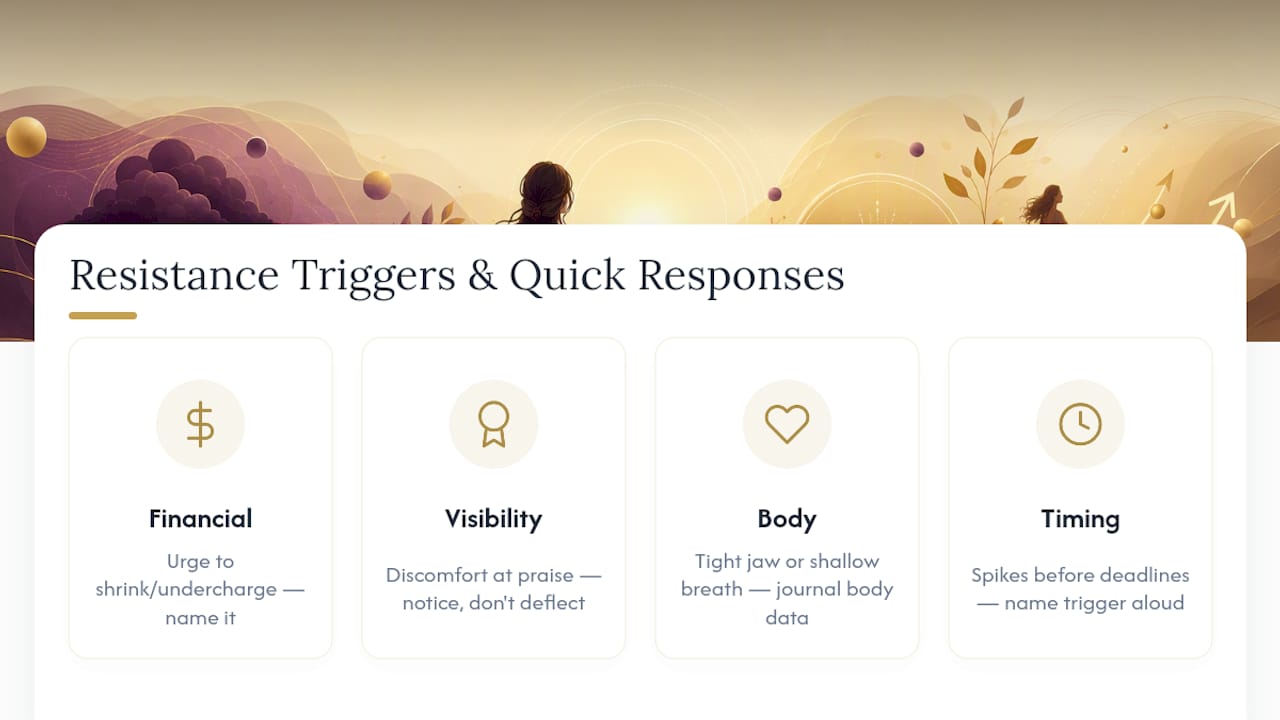
Financial conversations are one of the most common triggers, especially discussions of pricing, asking for payment, or receiving unexpected money. A sudden urge to shrink, apologize, or undercharge often signals an old wealth-identity wound rather than a genuine miscalculation.
Praise and visibility can trigger resistance just as strongly as criticism does. If a compliment or a public win makes you uncomfortable enough to deflect it immediately, that discomfort is worth noticing rather than brushing past.
Physical markers matter as much as emotional ones. A tight jaw, shallow breathing, or a sudden headache during a session are body signals, not distractions from your work. The journaling layers described earlier, body data separated from meaning, help you catch these triggers before your mind builds a story around them.
Timing triggers deserve attention too. If resistance spikes right before a deadline, a launch, or a decision with real financial stakes, that is often less about the guidance itself and more about the pressure of the moment. Naming the trigger out loud, even in a single sentence in your journal, is usually enough to loosen its grip.
What Strategies Actually Reduce Resistance During Healing?
Reducing resistance does not mean eliminating it. It means shrinking the gap between what you receive and what you are willing to test.
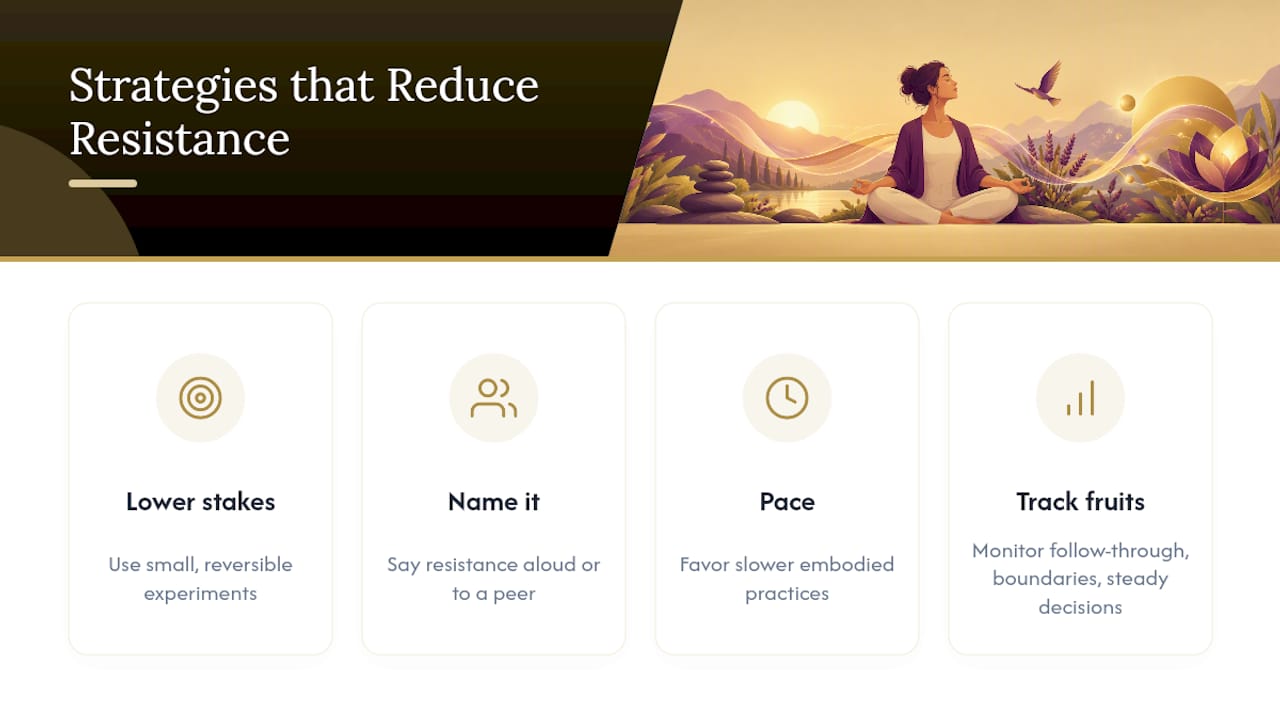
Start by lowering the stakes of any single action. Big, irreversible decisions activate the most resistance because the perceived cost of being wrong feels enormous. Smaller, reversible experiments, the kind described in the decision-record template above, let you gather evidence without betting everything on one interpretation of guidance.
Naming the resistance out loud, to yourself or a trusted peer, tends to reduce its intensity almost immediately. Resistance that stays unspoken often grows in the dark; resistance you can describe in a sentence becomes something you can work with.
Pacing matters more than intensity. The meditation survey of 613 practitioners found that embodied, attention-based approaches correlated with more stable experiences than intense, less-embodied methods. Slower, grounded work tends to outperform dramatic breakthroughs when you measure by what actually integrates.
Finally, track your own fruits over time instead of chasing bigger experiences. Consistent follow-through, clearer boundaries, and steadier decisions are the real markers of reduced resistance, even when they look unremarkable from the outside. A companion resource on releasing emotional blocks offers a practical first practice if you want a simple entry point before building your own routine.
Why Do Support Systems and Therapy Matter Here?
Resistance work is not meant to happen in isolation, and treating it as a solo project is one of the most common reasons people stay stuck. A trusted community gives you a mirror you cannot give yourself: someone who notices the pattern you keep repeating before you do.
Therapy and channel work are not competitors. They address different layers of the same person. A licensed therapist can help you process trauma, attachment wounds, or clinical concerns that sit underneath spiritual resistance, while channel and discernment work help you translate guidance into grounded action once that deeper healing is underway. Neither replaces the other, and Shantana Telise Healing’s programs are educational and spiritual, not a substitute for medical or mental health care.
Peer support inside a structured container matters too. Sharing your decision record with someone else, even briefly, forces you to articulate your assumptions instead of letting them stay vague. That accountability alone often surfaces resistance you had not noticed.
If your resistance is tied to functioning, the pause criteria covered earlier apply here directly: reach out to a qualified clinician when distress or impaired functioning is present, regardless of how spiritual the experience feels.
How Do Culture and Community Shape Healing Resistance?
The forms resistance takes are rarely universal. A heuristic study on spiritual resistance identified cultural conditioning as one of the primary drivers of resistance, and that conditioning looks different depending on where you were raised and what your community rewarded.
Women raised in families or cultures that discourage direct claims to authority often experience low-agency resistance more intensely, because trusting their own channel can feel like a rule violation rather than a growth step. Communities that equate financial ambition with selfishness can generate expectant resistance around wealth guidance specifically, since receiving abundance starts to feel like a betrayal of the group’s values.
Religious background shapes existential resistance too. If your upbringing framed direct spiritual experience as suspect or dangerous, that history can resurface the moment you start channeling on your own terms, even years after you have consciously left that framework behind.
Social context also determines how safe it feels to name resistance out loud. In communities that prize constant positivity, admitting to resistance or doubt can feel like a failure rather than useful information. Recognizing that your resistance is partly shaped by culture, not only by your personal psychology, makes it easier to work with rather than against it.
What Should You Prioritize First in This Work?
Most advice on spiritual resistance leans too hard into surrender. Push through it, trust it fully, let go of the need to understand. That framing sounds beautiful and it often leads women straight into decisions they cannot walk back, especially around money and business.
The research actually points somewhere more useful: resistance is frequently protective, and the goal is not to obliterate it but to test it. Discernment, not surrender, is the skill that keeps your channel trustworthy over time. A grounded decision record beats a dramatic download every time it comes to actual results.
If I had to name the single most overrated idea in this space, it is the belief that bigger, more intense spiritual experiences signal more progress. The evidence points the other way. Quiet, embodied, repeatable follow-through is what actually changes a life. Start there: name the edge, ask the bounded question, run the smallest reversible experiment. Everything else builds on that foundation.
— Shantana Telise
Ready to Build a More Grounded Channel?
Reading about resistance gives you language for it. Working through it consistently is what actually shifts your wealth identity and your capacity to receive. Shantana Telise Healing’s programs are built around exactly the discernment-first, embodiment-based approach covered in this article, applied to your specific edge instead of a general concept.
[

Each offer maps to a different stage of that work:
New to this practice? The Intuitive Income Reset is a $7 entry point for reconnecting intuition with income.
Looking for a deep, extended initiation? The Portal of the Gods is a ten-month container for divine power, love, and sovereign leadership.
Focused on developing your channel itself? The Art of Divine Channeling Masterclass is a nine-month channel-development program from her established body of work.
Sources
FAQ
Is Healing Resistance a Bad Sign?
No. Resistance is often protective, guarding a boundary, a pace, or a piece of unresolved fear, according to a heuristic inquiry on spiritual resistance. Treat it as information to test rather than a problem to eliminate.
How Long Does It Take to Clear a Resistance Pattern?
There is no fixed timeline, since it depends on the pattern’s depth and how consistently you run small, reversible experiments. Quiet, repeated follow-through tends to integrate a block faster than a single intense breakthrough attempt.
What Is the Difference Between Resistance and Spiritual Bypass?
Resistance is a protective block that slows or stops integration, while spiritual bypass is using spiritual language or practice to avoid dealing with a real emotional or practical issue. A meta-ethnographic synthesis found that spiritual bypassing often functions as an adaptive stage that resolves through integration rather than abandonment of spiritual life.
Can I Work on Healing Resistance Without a Program?
Yes, the discernment protocol and journaling layers in this article are usable on their own. Structured support, such as Quantum Wealth Channeling, simply gives you a guided container and accountability when you want to move faster.
What Does Quantum Wealth Channeling Cost?
The Core Experience is 2497 USD as a one-time payment, and VIP Private Access is 4196 USD as a one-time payment, both listed on the program page. The Intuitive Income Reset is 7 USD as a one-time entry offer for readers wanting a lower-cost starting point.
Recommended
Comments